

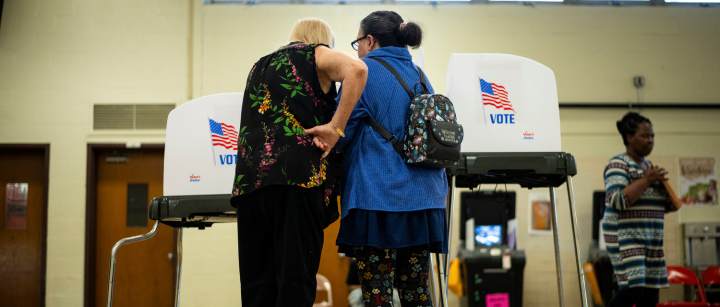
On March 17, the Senate began debate on the SAVE America Act, a Republican-backed voter identification and registration bill that passed the House last month. Here, we answer several questions about the legislation, many of them asked by our readers.
Previous versions of the bill, called only the SAVE Act, died in the Senate, where the measure hasn’t garnered 60 votes to overcome a filibuster and force a final vote. The new legislation could well face a similar fate — eventually — but the Republican leadership is holding a weeklong (or so) debate in an effort to attract support.
David Becker, founder and executive director of the nonpartisan Center for Election Innovation & Research, which works with election officials throughout the country, said in a March 18 media briefing that it was “extremely unlikely, if not impossible, that this passes.” He predicted that “next week, we’re not going to be talking about this.”
But this week, the Senate is going to be talking about it a lot. On the opening day of debate, Senate Majority Leader John Thune called the bill “a package of commonsense measures” that was about “ensuring that those who are registered to vote are eligible to vote – and that those who show up to vote at polling places are … who they say they are.” Senate Minority Leader Chuck Schumer called it “in every sense a voter suppression bill” that could “disenfranchise” millions of American citizens.
The SAVE America Act (or Safeguard American Voter Eligibility Act), passed the House on Feb. 11. The bill aims to prevent voting in federal elections by people who aren’t U.S. citizens — something that election experts say is a rare occurrence. Unlike last year’s SAVE Act, the bill also would require voters to present photo identification before casting a vote, whether by mail or in person. And states would have to use a Department of Homeland Security system to check the citizenship status of people on their voter rolls.
President Donald Trump has demanded that other measures be added to the legislation, including abolishing most mail-in voting.
We’ll explain more about the bill below.
Would registered voters be required to reregister with proper documentation to vote?
There’s no requirement in the bill for all registered voters to reregister. However, if a voter did need to reregister for other reasons, such as moving or changing their name, they would have to show documentation proving their citizenship. “Under any method of voter registration in a State, the State shall not accept and process an application to register to vote in an election for Federal office unless the applicant presents documentary proof of United States citizenship with the application,” the legislation says.
Ceridwen Cherry, legal director of VoteRiders, a nonpartisan group that helps people get an acceptable form of identification so they can vote, told us that “any change to the registration would require documents to prove citizenship under the SAVE America Act. The statute is drafted broadly enough to encompass all changes to registration.”
VoteRiders’ mission is “to eliminate ID barriers to the ballot box so every eligible voter can cast a ballot that counts,” and as such, it opposes this legislation.
Becker, who said the legislation would “expansively … alter voting in every single state,” costing “tens, perhaps hundreds of millions of dollars,” said voters would need to prove citizenship under the bill “any time you conduct what we call a registration transaction, which usually comes from a life event, a move or a change of name.” (He also said that “in talking with election officials across the country, I have yet to find really any election official who supports this on either side of the aisle. It would make their jobs extremely more difficult” while primaries are occurring and months away from the general midterm elections.)
Current federal law requires those registering to vote to attest that they are citizens under penalty of perjury. The SAVE America Act would require people to present citizenship documents in person to election officials, even if they are registering by mail.
What documents would be accepted to prove citizenship?
For most Americans registering to vote, proving citizenship would mean presenting either only a U.S. passport, or a certified birth certificate along with a driver’s license or other government-issued photo ID. The legislation lists requirements the birth certificate must meet, such as including the full names of at least one parent, the signature of an authorized government official, and the seal of the state or local/tribal government that issued it.
The Bipartisan Policy Center noted in a March 16 post that not all birth certificates include all of the criteria. About 53% of the U.S. population has a U.S. passport, according to Department of State data.
These are other types of documents besides a passport that would suffice to prove citizenship under the bill: a REAL ID driver’s license that indicates citizenship (five states have such “enhanced” driver’s licenses); a military ID and service record that says the person was born in the U.S.; or a government-issued photo ID that shows a U.S. birthplace. If presenting a government-issued photo ID that doesn’t say the person was born in the U.S. or has citizenship, a registrant would also need either the certified birth certificate or a hospital birth record, adoption decree, a consular birth report, a naturalization certificate, or an American Indian card with the classification “KIC,” which designates U.S. citizenship for Mexican-born members of the Kickapoo tribes of Texas and Oklahoma.
The Bipartisan Policy Center analyzed the 2024 Survey on the Performance of American Elections conducted by the MIT Election Data + Science Lab and found that 12% of registered voters lacked either a passport or a birth certificate along with a government-issued photo ID — the most common ways people would prove citizenship under this bill. The analysis also found that “wealthier and more highly educated voters are more likely to have documentary proof than others.” It found that “registered Democrats are more likely to have a valid passport than registered Republicans” and “Republicans are more likely to have a birth certificate than Democrats.”
According to a 2023 survey by New York University’s Brennan Center for Justice and other groups, more than 9% of Americans of voting age, or 21.3 million people, didn’t have easy access to citizenship documents, meaning they wouldn’t be able to “quickly find” such documents if they “had to show it tomorrow.” The percentage was 11% for Americans who did not identify as white.
In a summary of the bill, the nonpartisan Congressional Research Service explains that if people lack valid documents, “the bill would require states to establish a process whereby applicants could submit other documentation and sign an attestation under penalty of perjury that the applicant is a U.S. citizen and eligible to vote in federal elections.” If the person lacks documentation, the bill also would require the election official to sign an affidavit saying the registrant sufficiently demonstrated citizenship.
What about married women or others who have changed their names?
We received several questions from readers who are married, or divorced, and have changed their names, asking about how they can prove citizenship and ensure they can vote, should this bill become law. We wrote about these concerns last year as well. The bill includes a provision on name discrepancies, requiring states to establish a process for those registrations. (Again, voters who are already registered wouldn’t need to prove citizenship under legislation unless they needed to reregister.)
Cherry, with VoteRiders, told us that “if a voter has experienced a name change they would not be able to use their birth certificate as their only proof of citizenship as this document does not get updated if someone changes their name through marriage or divorce. They also could not use any of the other listed documents (e.g. passport) as their sole proof of citizenship if their name on the document does not match their current legal name.”
The bill requires states to set up a process to accommodate this. “Voters will either be able to provide ‘additional documentation as necessary to establish that the name on the documentation is a previous name of the applicant’ or ‘an affidavit signed by the applicant attesting that the name on the documentation is a previous name of the applicant,’” Cherry said. “The bill text does not lay out exactly what this process will be or what additional documentation would be accepted. It also leaves open the possibility for inconsistent rules between states.”
In general, the bill calls for the federal Election Assistance Commission, an independent, bipartisan agency, to issue guidance to states on implementing the legislation within 10 days of its enactment.
When we wrote about the SAVE Act last year, Wendy Weiser, vice president for democracy at the Brennan Center, raised concerns about criminal penalties in the bill for election officials. That provision remains in this year’s legislation. Weiser told us, “Any state process would be severely undercut by another provision in the bill making it a federal crime for election officials to register anyone who does not present ‘documentary proof of citizenship.’ How many election officials would be willing to risk incarceration and steep fines to register someone whose documentation does not match their current name?”
In a statement to us last year, Republican Rep. Chip Roy of Texas, who introduced the SAVE Act in the House and this year’s SAVE America Act, said concern over married women not being able to register to vote was “absurd armchair speculation.” He said the bill “provides a myriad [of] ways for people to prove citizenship and explicitly directs States to establish a process for individuals to register to vote if there are discrepancies in their proof of citizenship documents due to something like a name change.”
What identification would people need in order to cast a vote?
New in this year’s legislation is a nationwide voter photo ID requirement. Those voting in person would need to present “a valid physical photo identification” in order to cast a ballot. Those voting by mail would need to provide a copy of the photo ID.
Those who don’t have an ID for in-person voting could cast a provisional ballot and then would have three days to present their ID to election officials — or sign an affidavit “attesting that the individual does not possess the identification required … because the individual has a religious objection to being photographed.”
For by-mail voters, they also could submit the last four numbers of their Social Security number and an affidavit “attesting that the individual is unable to obtain a copy of a valid photo identification after making reasonable efforts to obtain such a copy.”
A valid photo ID for this purpose includes: a state-issued driver’s license or ID card issued by the motor vehicle agency that includes a photo and expiration date, a U.S. passport, a military ID, or a photo ID issued by a tribal government that includes an expiration date.
The National Conference of State Legislatures, which tracks state legislation, has said that these voter ID requirements “are stricter than those that exist in most states.” In a Feb. 19 post, NCSL staff wrote, “While 36 states currently have voter ID requirements to vote, state approaches vary. Just 10 states fall into the strict photo ID category, as defined by NCSL.”
An acceptable ID for these 36 states “often includes student IDs, hunting and fishing licenses or other state-specific identification cards.” Thirteen states accept non-photo identification, such as a bank statement. That’s broader than what the SAVE America Act would accept.
There are exceptions to the by-mail ID requirements for overseas uniformed services members and those who have the right to vote absentee via the Voting Accessibility for the Elderly and Handicapped Act.
How often have noncitizens voted in federal elections?
We’ve written about this issue a few times. Last April, we explained that detailed audits of voting records by some states had found instances of noncitizens casting votes to be relatively rare. In some cases, officials in those states found hundreds of noncitizens on voter registration rolls, a fraction of whom also voted.
Noncitizens convicted of voting in federal elections face fines, jail time and deportation.
“The evidence is that the number of noncitizens illegally voting in federal elections is extremely low, not high enough to have changed the party outcome of any federal election in recent years,” Walter Olson, a senior fellow at the Cato Institute told us. “Audits and investigations in states like Ohio, Nevada, and North Carolina have found the numbers to be tiny in relation to votes cast. … The consistent experience has been that very few persons in this category mistakenly or deliberately vote.”
For instance, the Ohio Secretary of State announced in May 2024 that it found 137 people on the state’s voter registration rolls who had twice confirmed their noncitizenship status to the state motor vehicles bureau. The announcement didn’t say whether any had tried to actually vote. A grand jury indicted six people who legally and permanently immigrated to the U.S. for voting illegally as noncitizens between 2008 and 2020. In Georgia, a 2022 review found that 1,634 people had attempted to register to vote between 1997 and 2022 and could not be verified as citizens. None had voted. In October 2024, the Associated Press reported that Georgia election officials said 20 out of the 8.2 million on the state’s voter registration rolls were not U.S. citizens, and that nine had voted in previous elections.
The Bipartisan Policy Center analyzed a database of fraud cases compiled by the conservative Heritage Foundation and found “only 77 instances of noncitizen voting between 1999 and 2023.”
Last April, we were writing about unsupported claims from Elon Musk and the Department of Government Efficiency to have found evidence of large-scale voting by noncitizens. DOGE said it provided data to federal prosecutors for investigation. But nearly a year later, nothing has been made public about that investigation.
More recently, a systematic review of claims about noncitizen registrants and voters in all 50 states by the Center for Election Innovation & Research, updated in February, found that “sweeping allegations about noncitizen registrations or voting appear to arise from misunderstandings, mischaracterizations, or outright fabrications about complex voter data. In every examined case, when claims about large numbers of noncitizens on voting rolls are subject to scrutiny and properly investigated, the number of alleged instances falls drastically.”
What do we know about the DHS citizenship verification system?
Numerous states recently have used a Department of Homeland Security program called the Systematic Alien Verification for Entitlements, or SAVE, to check the citizenship status of people on their voter rolls — something that the SAVE America Act would require. The bill says that states should use the system “for the purposes of identifying individuals who are not citizens of the United States and taking the necessary steps to remove such individuals who are not citizens from the official list, after notice is given to such individuals and such individuals are given the opportunity to provide documentary proof of United States citizenship.” The legislation doesn’t provide more information on how these notices and opportunities to fix a mistake would be carried out.
Recent reporting shows the SAVE database has flaws.
According to a January New York Times article, 49.5 million voter registrations have been checked in several states, and the Department of Homeland Security referred about .02%, or 10,000 cases, to investigators. The Times found that when some counties began looking into the cases, it turned out that only a fraction of them were potentially noncitizens. There was no indication of how many of those who may have improperly registered to vote actually voted.
Texas, too, found there were errors in DHS’ SAVE database. In October, the state said the database identified 2,724 potential noncitizens in its voter rolls of more than 18 million people, and it referred the cases to Texas counties. Many of those counties found U.S. citizens were among those flagged.
In February, ProPublica and the Texas Tribune wrote that their examination of the SAVE system “reveals that DHS rushed the revamped tool into use while it was still adding data and before it could discern voters’ most up-to-date citizenship information.
“As a result, SAVE has made persistent mistakes, particularly in assessing the status of people born outside the U.S., data gathered from local election administrators, interviews and emails obtained via public records requests show. Some of those people subsequently become U.S. citizens, a step that the system doesn’t always pick up,” the news organizations wrote.
Are a majority of voters in favor of the SAVE Act or the SAVE America Act?
Yes, according to a February Harvard CAPS/Harris poll, which found that 71% of the registered voters surveyed said that they supported the SAVE America Act, including 91% of Republicans, 69% of independents and 50% of Democrats.
The online poll conducted Feb. 25-26 asked 1,999 registered voters, “Do you support or oppose the proposed SAVE America Act that would: Require proof of citizenship to register to vote, Require voter ID, Require states to remove non-citizens from their voting rolls, Require states to share unredacted voting rolls with the Department of Homeland Security.”
Three out of the four proposals mentioned in that description of the bill appealed to an even larger group. A press release about the results of the Harvard CAPS/Harris poll said, “The majority of voters support specific requirements of the Act, including proof of citizenship (75%), voter ID (81%), states removing non-citizens from voter rolls (80%), and states sharing redacted voting rolls with the Department of Homeland Security (61%).”
Past polls have revealed similar levels of support for some of those policies.
A Pew Research Center poll from August found that 83% of those asked were in favor of a requirement for everyone to show government-issued photo identification before voting, including 95% of Republicans and 71% of Democrats.
In addition, a Gallup poll from October 2024 found that 84% of surveyed adults supported “[r]equiring all voters to provide photo identification at their voting place in order to vote,” while 83% backed “[r]equiring people who are registering to vote for the first time to provide proof of citizenship.” About two-thirds of Democrats supported both ideas, more than 8-in-10 independents did, and nearly all Republicans were on board with each.
Becker, of the Center for Election Innovation & Research, noted that the results of these surveys depend on what questions are asked. “If you just ask the regular question in polls, do you support voter ID, you do see vast majorities of Americans say yes, including majorities of Democrats. If you ask people, should eligible voters without voter IDs be disenfranchised, you get very different responses.”
The Harvard CAPS/Harris poll also asked, “Which of the following is more important?,” giving two choices. A little more than half, 54%, said, “That we do everything possible to stop voter fraud and illegal immigrants from voting,” and 46% said, “That eligible citizens aren’t denied the ability to vote.”
What has Trump said about eliminating voting by mail?
Trump has proposed that the final version of the bill also eliminate mail-in voting with limited exceptions.
“We don’t want mail-in ballots,” Trump said while talking about his proposal during an interview with a Cincinnati news station on March 11. “We don’t want to have ballots coming from all different corners of the world. We want to have it accurate, and you can’t do that with mail-in ballots.”
In multiple posts on social media in March, the president has written, “NO MAIL-IN BALLOTS (EXCEPT FOR ILLNESS, DISABILITY, MILITARY, OR TRAVEL!).”
As is, the House-passed bill would not abolish mail-in voting, but it would require identification to both request and submit a mail-in ballot.
As we’ve reported, mail-in voting is used widely throughout the U.S. Eight states and Washington, D.C., conduct their elections mostly by mail, according to the National Conference of State Legislatures. In addition, 28 states allow “no excuse” mail-in voting, which means that voters don’t need to provide a reason when requesting a mail-in ballot.
In the August Pew Research Center poll, 58% of respondents said they supported allowing any voter to vote by mail.
Elections experts have told us for years that while fraud is slightly more prevalent with mail-in voting than in-person voting, it is still relatively rare and not widespread.
What else does Trump want in the bill?
More recently, Trump has said that he wants the legislation to address two non-election-related issues.
“I added on no men playing in women’s sports, and I added in no transgender surgery, the mutilation of our children,” Trump said from the Oval Office on March 16, referring to his proposed ban on transgender women playing in women’s athletics and gender-affirming surgery for minors.
Those are the last two of Trump’s five-point plan for the bill, and Republican Sen. Eric Schmitt of Missouri has introduced an amendment to include all five parts in the final legislation.
“I’ve worked closely with President Trump and the White House to introduce a substitute amendment that will save our elections, save women’s sports, and save our children from gender mutilation surgeries. It’s time to get this done,” Schmitt said in a March 17 statement.
In all, Schmitt said his amendment would: “Require all voters to show ID,” “Require proof of citizenship to vote,” “End mail-in balloting with exceptions for military, illness, travel, and disability,” “Keep men out of women’s sports,” and “Protect children from transgender mutilation surgeries.”
Robert Farley contributed to this article.
Editor’s note: FactCheck.org does not accept advertising. We rely on grants and individual donations from people like you. Please consider a donation. Credit card donations may be made through our “Donate” page. If you prefer to give by check, send to: FactCheck.org, Annenberg Public Policy Center, P.O. Box 58100, Philadelphia, PA 19102.
Source link
